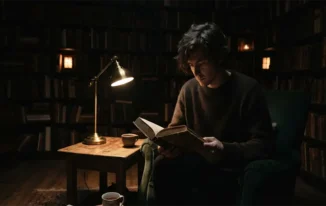
The afternoon hangs suspended, thick with the scent of wild fennel, sun-baked earth, and the faint, sweet decay of cured meadow grass. In the middle of an untamed field where Queen Anne’s lace bows under its own delicate weight, time has forgotten how to march. There is only the low, cathedral hum of bumblebees, the slow drift of a solitary cloud across an impossibly blue sky, and a figure folded into the landscape like a dropped petal.
She sits with her back against the slope of a gentle knoll, knees drawn up under a skirt of washed linen that pools in the clover. This is not merely an escape from the interior walls of a house; it is a total surrender to the horizontal vastness of the world. In an era that measures existence in notifications and rapid-fire exchanges, taking up residence in a sun-dazed field with a book is a radical act of reclamation.
Setting the Scene: The Architecture of an Outdoor Sanctuary
To build a momentary sanctuary in the tall grass requires an instinctive understanding of comfort. A faded ticking-stripe blanket is spread over the chicory and buttercups, serving as a modest threshold between human habitation and the wild, creeping carpet of the earth. Beside her, a scuffed leather satchel spills the detritus of a slow day: a half-eaten peach wrapped in parchment, a small enamel cup of cool water, and a wide-brimmed straw hat cast aside to let the wind catch sun-bleached strands of hair.
The portrait is one of unstudied ease. Sleeves are rolled past the elbow; bare ankles rest directly against the warm, porous soil. There is no rigid posture here, only the fluid alignment of a body adjusting itself to the contours of the hill, finding the exact angle where the afternoon heat feels less like a burden and more like a golden embrace.
The Symbiosis of Text and Nature
Open the book on her lap—a well-worn paperback with a sun-warped spine and dog-eared corners—and watch how the external environment begins to edit the internal narrative. Reading indoors is a private, disembodied journey, but reading outside is an ecological collaboration.
A sudden gust of wind sweeps across the meadow, rippling the sea of green and forcing a crisp flutter of the paper pages. A shadow from an overhanging dock leaf drifts across the second paragraph of chapter four. The scent of pine resin rides on the air just as a character in the story steps into a forest.
- The Living Margin: The real world does not interrupt the story; it annotates it. The chirp of a cricket becomes the natural punctuation mark for a complex sentence.
- The Slow Cadence: Where the digital screen demands frantic scanning and instant cognitive processing, the printed word in the open air invites a rhythmic, tidal breathing. You read a sentence, look up to watch a hawk carve an effortless arc against the white glare of the sky, and return to the line without a shred of guilt.
- Tactile Resonance: The grit of dry pollen on a thumb, the heat radiating off the cardboard cover, and the rough grain of the paper combine to create a deeply physical memory of the text.
Anatomy of a Quiet Afternoon: Passing Time Without Urgency
Hours dissolve with the quiet efficiency of melting sugar. The sun, which began its tenure at the crown of the sky, begins a long, slanting descent toward the tree line on the western ridge. The amber quality of the light shifts, turning the green stalks into needles of spun brass and casting long, cinematic shadows that stretch out like resting hounds.
There are frequent, luxurious pauses in the reading. Her finger holds her place midway down page one hundred and twelve, but her gaze is fixed ten feet out, watching a line of ants negotiate the obstacle course of a fallen twig. She touches the bruised skin of a ripe peach, feeling the soft velvet of the fuzz. These pauses are not distractions from the book; they are the true destination. The book is simply the anchor that keeps her tethered to the spot while the world revolves around her.
The Lingering Afterglow and Closing Reflection
As the violet of early evening begins to dilute the gold of the afternoon, the temperature drops by a single, perceptible degree. The hum of daytime insects fades, replaced by the sharper, rising chorus of crickets tuning up for the night shift.
She closes the book with a soft, dull snap that sounds remarkably loud in the settling stillness. She gathers the corners of the linen blanket, shakes out the clinging seeds of wild grasses, and stands up, stretching her arms toward the fading horizon.
She carries the meadow back with her—not just on the hem of her skirt or the scent in her hair, but in the slow, unshakeable quiet behind her ribs. The noise of the city, the demands of the schedule, and the tyranny of the urgent will return soon enough. But for now, she walks down the dirt path holding the portable peace of a sun-drenched afternoon tucked securely beneath her arm.